
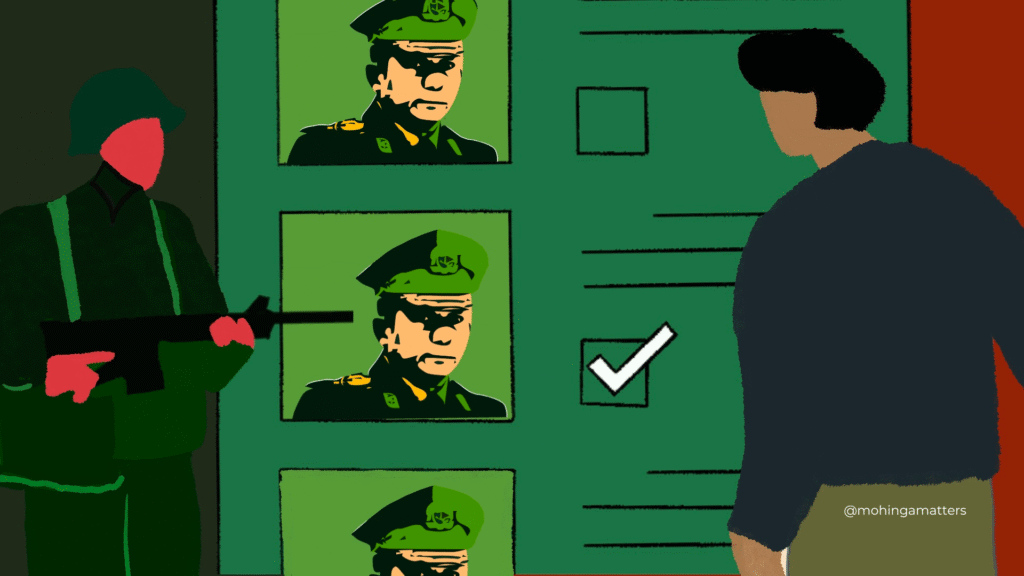
The regime is holding the election nearly five years after the coup. In regions and areas where they have complete control, they are using only the systems they trust, and relying on the political parties of their friends and acquaintances. This election is considered an exit strategy for the coup; a smooth transition to a so-called “civil” government. They have done everything in their power to make it happen.
We have reported endlessly on why and how the military coup is illegal. Now, we must document and prove that the election is illegal — but in a way that does not legitimize it as a result.
This month, we spoke to one of the seasoned experts on monitoring elections and parliaments in Myanmar.
Please share with us what role you played in the previous elections.
In the 2010 election, there was no such thing as election monitoring. I was also a young person then, only witnessing it from the outside. In 2011, I began working as a reporter in the parliament. After that, I transitioned to working with a civil society organization. During my two years covering the parliament, I realized that more people should be aware of the issues being discussed there. This realization sparked my interest in promoting public understanding of parliamentary affairs. In 2013, together with other like-minded individuals, I began observing parliamentary activities as part of a civil society initiative. Our goal was to raise public awareness about parliament’s work through observation and research. We continued this work during the 2015 election, the 2017 by-election, and the 2020 general election. Unlike short-term observers, our election observation is a long-term process, looking at activities and development before, during, and after elections. Since the electoral system directly shapes emerging parliaments and the political landscape, we believe that monitoring elections also requires continuous observation of parliamentary outcomes and the political landscape that is developed from them.
By the 2015 election, our research group had collected information from the parliament. This information showed which members of parliament had been active over the past five years and which had not. Then we shared this information with the public through various channels so that they could make more informed choices when casting their votes.
In addition, during the election period, we conducted research to help both local and international observers understand the political and parliamentary systems that would emerge from the election. This was our primary involvement. Rather than focusing only on the campaign period or election day itself, our work emphasized long-term monitoring of the political system before and after the election.
This election is based on the 2021 coup, which is widely considered to be illegal, both by the people and the international community. How legitimate is the election organized by the military? There are already several controversies such as voter lists, the limited areas to hold elections, etc. If we get into the irregularities, will it give legitimacy to the entire election? And consequently, will it give legitimacy to this coup?
This issue has been a recurring question since the 2012 by-election. The 2010 election was widely boycotted by civil society and political activists. Reports and media coverage of the 2010 election clearly indicated that the election was neither free nor fair. The international community largely accepted that assessment. As a result, the parliaments formed in 2011 and 2012 following that election attracted little public interest or engagement.
Once the NLD entered the parliament with strong nationwide public support in the 2012 by-election, the electoral and parliamentary systems began to gain a measure of legitimacy, rooted in the will of the majority. Therefore, since 2012, the 2008 Constitution has remained in effect, and we have had to acknowledge and operate within that reality, essentially granting it a degree of legitimacy.
Now, when we talk about the 2025 election, it is going to be an election held by the military, backed by guns. It is completely illegal, not only because the military has seized power. If we consider the participation of political parties, there is no legality. Only the military and its allies are involved. Looking at the entire electoral system, it is not truly an election; it is just a show with ballot boxes. In this sense, it has no legitimacy at all.
However, although most civil society organizations boycotted the election in 2010, they also took the initiative to record the extent to which the former military administration oppressed both civil society and ordinary citizens. In essence, this was documentation of widespread human rights violations committed during the election period. This kind of recordkeeping is crucial not only for exposing the truth but also for challenging the legitimacy of the election itself.
So, during the upcoming election period, there is no need to send observers. Sending them would, in effect, grant legitimacy and make you a participant in the election to some extent. Deploying election observers signals that the system recognizes this election as an election worth observing, which it is not. However, what is important is that we must systematically document how the votes are rigged, how the process is manipulated, and how the people’s rights are violated. On the ground, the military may resort to violence during the election period, such as coercing or threatening the public. These incidents require monitoring.
If we can clearly demonstrate the ways in which the process is manipulated and the people’s rights are violated, we can also question the foundation of the system that emerges from it. In this scenario, I believe that monitoring such violations is essential and that would not grant the election any legitimacy.
As far as we understand, there are only around six political parties that will contest in the entire country. Elections will take place only in 270 townships, which is very few compared to the elections in the past. They said that they will hold elections in installments. Have you seen this kind of election held in phases before?
There has been no such thing as an election held in phases in modern Myanmar history. I have not studied it. However, in the pre-independence era, elections were held under a system of divided constituencies.
Holding general elections in installments is problematic. General elections are meant to elect a central government that will govern the entire country. If an election for a central government is held with different phases, people’s views on candidates at each stage may alter, and the political landscape may not be the same throughout these phases.
For example, the military junta will hold elections only in the areas it controls. By dividing the election into phases, they have many tools at their disposal: buying votes with money, using guns to get the votes, and other methods. Ballot stuffing is another example, fake advance votes, large numbers of ballots stuffed into boxes, or votes stolen in bulk.
In the recent announcements, Yangon is not in the first phase of the election. Yangon is pretty much under military control. It is even beneficial for them to take photographs of people voting and publish them in their media outlets. But if the first election in Yangon is not successful because half of the people do not vote, they will use various methods of violence and pressure to prevent the same outcome in the second phase.
I have not even discussed the results, which they can also manipulate to their advantage. When there is a gap between phases, it seems to me that it is a deliberate design to secure the votes they want. Usually, general elections are held simultaneously across the country so that campaigning is consistent and public opinion remains stable. Here, however, by observing the initial results, the authorities can anticipate how people might respond and adjust their methods to influence subsequent phases.
The military announced that it would use a Mixed-member Proportional system, combining First-Past-the-Post (FPTP) and Proportional Representation (PR). Is the PR system bad simply because it is implemented by the military? If it were implemented by civilians, could it be beneficial??
Since 2014, there has been a demand in parliament to use the PR system. Smaller parties saw the PR system as an opportunity to gain more seats. They demanded that the PR system be applied only in the lower house, Amyotha Hluttaw. However, these efforts were not successful.
Now, Min Aung Hlaing will implement the PR system. The NLD and the majority Bamar parties are no longer on his side, and some parties are likely to boycott. So he is trying to form alliances with ethnic parties that he can influence using the PR system to help them gain more seats in parliament.
The real issue lies in the details. It is not the PR system itself, but how it is designed and implemented that determines whether it serves a fair or manipulative purpose. Now, they are combining PR and FPTP to use in Amyotha Hluttaw. They call it a Mixed-member Proportional system. Six members will be elected using FPTP, and six members will be elected using PR. That is part of the system. In reality, it is a mixed-member proportional system similar to those used in countries like South Korea, Japan, and some European countries. In such systems, the results from FPTP and PR must be adjusted to balance the overall representation.
The current Mixed-member proportional system implemented by the military junta does not include such an adjustment mechanism. It is a system in which the strongest party wins the majority of the seats. As a result, it is difficult for smaller parties to gain representation. Although it is called a PR system, the very benefits and fairness of proportionality have been removed. Another point is that the PR is applied in Amyotha Hluttaw but not at the state/regional level. In this situation, Min Aung Hlaing claims he wants smaller parties to win by offering PR, but in reality, this is not true.
The 2019 election in Thailand, held under a military dictatorship, is the closest to the regime’s proposed system. It caused many problems in Thailand and is no longer in use there. Accepting this electoral system now would mean carrying it forward to the next generation.
From 2010 to 2020, we tried to amend the 2008 Constitution, which we considered flawed and difficult, but we failed. If we accept the system created by Min Aung Hlaing, the democratic mechanisms and processes for the next 10 to 20 years will be severely undermined.
It is not simple for even an expert like you to explain the new electoral system. For ordinary people, it will confuse them quite a lot. Do you think the regime intentionally creates such a system so that people hardly understand and make mistakes?
Normally, if we are going to hold an election with a new system, the first step is to amend the electoral law and engage in discussions with political parties. The parliament must approve these changes. Then, the public will be informed through news coverage. Civil society organizations can follow along by reviewing draft proposals as they are released. Through these discussions, people can understand what the new electoral system will look like and how the voting will take place. Citizens then have the right to participate, evaluate the system, and determine which aspects are acceptable and which are not.
Another issue is that, in a properly organized election, the people responsible for polling stations and the election commissions need to familiarize the election system in advance, often many months before voting begins. When they are familiar with the system, they can identify potential violations. Currently, these election commission officials themselves do not fully understand the new system, laws, or regulations that will govern the election. Now, none of this preparation exists.
Another issue concerns the people who will be in charge of polling stations: those who issue ballots and oversee the voting process. With the electronic voting system, voters may simply press buttons, but hundreds of thousands or even millions of people are responsible for managing the polling stations.
As far as I know, those in charge do not have previous experience like teachers. Many of the experienced staff are part of the CDM, having left their posts after the coup. Now, people with no prior election experience are being assigned to polling stations. These people are not equipped with extensive or thorough training on the election process and the system. Careful preparation and training of polling station staff are crucial for a successful election. The fact that this is not being done is not a strategic choice; it reflects a lack of skill and capacity to manage the process properly.
As I explained earlier, when the military was trying to secure victory using a complicated system, the current Election Commission had to design such a system to guarantee a win for the military. Therefore, the Election Commission does not have enough capacity to follow through the complex system they created.
Another issue is a lack of political will. They have announced that the election will be held in three phases, yet the dates, townships, and details of each phase have not been released. But not only do voters lack this information; political parties planning to contest the election do not seem to know the details. I see no effort to provide clarity. The lack of will is the most evident when they choose not to release basic information which requires no expertise or technical difficulties.
There is no specific information about when the parliament will be called or when the new government will be formed after the three phases of the election. Is this delaying their strategy, or do they not intend to actually call the parliament and form a government? What do you think?
My general guess is that they will complete all three phases of the election in January. Once the results are announced, the process will be finalized by the end of February. The same timeline was followed in 2010 and 2015: the first session of parliament was announced in late February or early March, and a new government was formed in late March or early April. I expect they will follow a similar schedule. I believe they will follow the due process because they want to undermine the legitimacy of the Committee Representing Pyidaungsu Hluttaw (CRPH) and the National Unity Government (NUG); by attempting to show that their term has expired. I do not think this will be a prolonged process.
Regarding the voting method, it has been announced that electronic voting with Unique Identifier (UID) numbers will be used. How risky is this system for voters?
If we are going to use an electronic voting system, the key requirement is ensuring the integrity of the system. People need to trust the system and data behind the system: how it is stored, where it is stored, who manages it, and how the system is developed. For the system to be truly trustworthy, all of this must be guaranteed. For example, if an electronic voting system is used in an election conducted by an independent election commission under a civilian government, the commission must clearly communicate to the public: where this system was purchased, where the hardware was sourced, the company that developed it, or if the software ensured integrity, prevent fraud, and correctly calculate the results, how the information you enter when you vote will be stored in the machine, and for how long, who have access to it, etc. We have no information about any of this, and that is why I find this system hard to trust.
What’s even more concerning is the use of the UID. The UID will be used to force people to register to vote. Once registered, people are already in the system. Through the UID, authorities will know people’s personal information and whether they vote or not. If someone doesn’t vote, they could be arrested and imprisoned under the Election Protection Act as someone who opposes or refuses to support the election. Even if they are not imprisoned, they could still be tracked.
We don’t know how the military will use this data if it falls into their hands. Even if a civilian government comes to power, what will happen if the military continues to oppress because it still has access to the data? This may seem like a fear-mongering scenario, but I believe it is a very real and worrying concern.
The regime has issued various laws regarding the election, which prevents citizens from criticising the election. That is the domestic situation. Another thing is that some international election observers will not be sending election observer teams to avoid giving any legitimacy, so there will be little to no discussion about the election inside and outside the country. What will be the consequences of this issue?
Domestically, people will be suppressed through various laws, mechanisms, and methods. The amendment of the Protection of Personal Privacy and Personal Security of Citizens Law is extremely important. It means that the military junta’s mechanisms can spy on people, listen to their phone calls, and enter their homes without a warrant. They can also arrest people on the street and search them. Once arrested, individuals may be detained for more than 24 hours without their whereabouts being disclosed.
On the other hand, there is the Cyber Security Law. People have been arrested simply for using a VPN under this law. Similarly, under the Election Protection Law, individuals can be arrested for making statements about the election. Even those who want to monitor the election cannot do so, as criticizing or analyzing the process can lead to arrest. It is not easy for people to abstain from voting in such a context. With widespread surveillance and pressure, citizens can be coerced into polling stations and forced to vote. This is not merely a hypothetical scenario; it is a real threat.
People abroad cannot go to the ground to monitor the elections directly. What they can do, however, is document human rights violations that occur during the election period. Even though we are not observing the elections directly, we must continue to monitor the human rights abuses that increase during the election period.
Our people, after all we have endured, have a strong desire to respond to such circumstances. I believe we will find a way. We will be able to document human rights violations during the election period. I believe that documentation will continue to be carried out by citizen journalists. For those outside the country, the key questions are: how do we collect this information safely, and how do we transmit it to international mechanisms? How do we ensure it reaches international media? I believe these steps are crucial.
By doing so, we can record for history that this election was not a legitimate election. Only by documenting it in this way can we undermine the political system emerging from the election and the authority of those who come to power through it.
If we accept this election, our next generation may face even worse consequences. Our country and our land should never become a place where democracy, human rights, and federalism fail to develop. We can’t let the military junta use the election as its exit strategy. I believe we need to work together to put on record that this is not a genuine election.
Would you like to add any final remarks?
When we talk about elections, people in the country always ask, “What should we do? We are being forced to go to the polling station. We are pressured and threatened.” In my opinion, if citizens have no real choice, they will have to go to the polling station and vote. We all have to understand that reality.
What we need to do, both domestically and internationally, is work together and share information about the situations and events we are facing. Today, we have more ways to share information than ever before. We need to document and share our experiences, the abuses and threats we have faced, and the injustices we have witnessed. These are all violations of human rights and political rights. By documenting these violations, we can ensure that the world is informed and that these events are recorded in history. When we seek truth and justice, it is essential to document this election as a tactic of the military rather than a genuine electoral process. To document the violations, incidents, experiences, threats, and acts of violence we have faced, I encourage everyone not to stop at personal levels. We should use safe methods to record, share, and archive this information collectively.
Another point is that those abroad, whether civil society organizations or media outlets, shall work together to collect and integrate this information. I believe we should all collaborate to systematically document these events. I do not believe that our country will remain in conflict forever. We have faith that one day it will become an independent nation, free from military dictatorship.
I believe in every citizen and every soldier who participates, whether they are inside or outside the country. Each of us has the desire, the ability, and the purpose to contribute. I strongly encourage everyone to work together to make this happen.